Showing posts with label Porcelain. Show all posts
Tuesday, 13 March 2012
Boehm - Crocus
E. M. Boehm, now Boehm Porcelain, is the artisan studio founded by sculptor Edward Marshall Boehm and wife Helen Boehm in 1950. It is today recognised as one of the world’s foremost porcelain studios. Boehm fine porcelain sculptures and open collection and limited edition collectibles, as well as historically-commissioned pieces are created by highly skilled artisans in the same Trenton, New Jersey studio in which the company was founded.
Art from the Boehm studio has been presented to Her Majesty Queen Elizabeth II, Pope John Paul II, Mikhail Gorbachev and every U.S. President since Dwight Eisenhower. Boehm Porcelain is currently showcased globally in the homes of discerning collectors and celebrities as well as the world’s foremost museums and galleries including the Metropolitan Museum of Art, the Hermitage, the Smithsonian, the John F. Kennedy Centre for the Performing Arts, the Tokyo National Museum, the Israel Museum, the Singapore Art Museum and the Abdine Palace in Cairo. Boehm porcelain is the only American art form to have two dedicated rooms in the Vatican Museum in Rome.
Royal Doulton Flambé Series
FLAMBÉ
The Royal Doulton Flambé Collection is some of the most popular and iconic ceramics ever to be produced in Britain. With it unique and eye catching red and black glaze flambé has and will always be hugely collectible. The brilliant red glaze was created over 500 hundred years ago in China, when they began to experiment with Copper oxide glazes. However, even though the flambé glaze has been around for hundreds of year it was mostly forgotten about - especially in the West.
From what little knowledge remained of the flambé technique John Slater and Charles Noke (At Royal Doulton) embarked upon a two year long mission to bring back this ancient technique. After the first showing at the St. Louis Exhibition in 1904 flambé took off and has remained popular ever since.
For a chance to own a piece of Royal Doulton flambé visit Just Pip it
Tuesday, 6 March 2012
LLadro Stamps.
Lladro was originally started by 3 brothers. In the beginning they started by producing table are but then soon moved onto the figurines we know today.
The Figurines are instantly recognisable because they are made from hard paste porcelain. The techniques and ingredients for this particular method are kept a closely guarded secret, only known by a few.
This Lladro stamp is used exclusively for the Lladro Collectors Society mark for their "Members Only" figurines.
This was introduced in 1990 abd in use today. It had an altered bell flower and different typeface.
The sixth stamp used by Lladro added a copyright date and was used from around 1984 to 1989.
Used from 1977 to 1984. with the copyright acronym DAISA (Disenos Artisticos E Industriales, S.A.)
This trademark was used from about 1971 to 1974.
This Lladro mark was used from 1974 to 1977.
This trademark replaced the initial one and was used from around 1965 to 1970.
The original Lladro trademark was used between 1960 to 1963.
There are many Lladro items on sale at Just Pip it along with many from the LLadro Nao series
Monday, 5 March 2012
Meissen Porcelain
We currently have a couple of Meissen Porcelain items for sale at Just Pip It:
Please follow the links below for more information:
Meissen Guinea Fowl
Meissen Lady of Harvest
And more porcelain items at Just Pip It: Collectables
Please follow the links below for more information:
Meissen Guinea Fowl
Meissen Lady of Harvest
And more porcelain items at Just Pip It: Collectables
Thursday, 1 March 2012
Wanted Meissen Porcelain!
Meissen porcelain is the first European hard-paste porcelain manufacturer. Dating from 1708 and made in Meissen, near Dresden is famous for its fine, high quality porcelain. Its signature logo, the crossed swords was introduced in 1720 is one of the oldest trademarks in existence.
Just Pip It are looking for all Meissen works.
The Meissen logos:
![]() |
| 1723-25: Original KPM mark with blue crossed swords beneath |
![]() |
| 1725-32: Original blue crossed swords with curved crosspieces and handles |
![]() |
| 1732-73 Dot Period blue crossed swords mark with dot between crosspieces |
![]() |
| 1773-1814 Marcolini period blue crossed swords mark with asterix below or between crosspieces |
![]() |
| 1814-1824 Blue crossed swords with straight hilts and vertical bar below |
![]() |
| 1825-1924 Blue crossed swords mark with curved handles |
![]() |
| 1924-34 Blue crossed swords mark with dot between top of blades |
![]() |
| 1945-1947 Blue crossed swords mark with crescent below |
![]() |
| 1947-1973 Blue crossed swords mark with straight crosspieces |
![]() |
| 1974- Present Blue crossed swords mark with Meissen name in logotype script below |
If you are looking to sell your Meissen porcelain, please get in touch.
Royal Worcester Porcelain
Royal Worcester porcelain was founded in Worcester, England in 1751. By 1755 Worcester porcelain was making the best English blue and white porcelain money could buy. By 1789,Worcester received a royal warrant. Meissen porcelain was also greatly admired in England in the 1750's, but its import was restricted and so English manufacturers imitated the Meissen wares.
Worcester porcelain is split into periods of times:
1: The first period refers to pieces made until 1783 when Thomas Flight purchased the company.
2: Regency refers to those items made when the name changed frequently
3: Royal Worcester refers to pieces from about 1862 onwards.
Beware of imitations: Early Worcester porcelain was soft-paste. If a piece claims to be early, but is hard-paste porcelain or bone china.... it's a fake!
Royal Worcester Marks:
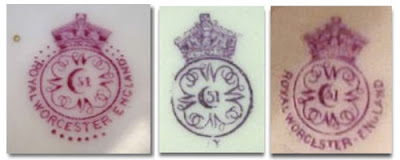
Early marks show the crown slightly above or perched on the circle and from 1876 the crown sits down on the circle. The mark can appear in any colour. In 1862 a new factory mark was introduced along with date coding sequences.
From 1862 till 1867, the last two numbers of the year would be used. From 1867 to 1877 the code would either be the last two numbers or a capital letter under the circle representing the date.
From 1877 the year number was dropped in favour of the letter system. In 1891 the mark changed once again and no date letter was used but 'Royal Worcester England' appeared around the circle and dots marked its year of production.
The dating system continued until 1915 when 24 dots were arranged around the standard printing mark. The dots system was getting too fussy so they were replaced by a single asterisk in 1916 followed by a new dot system. This until 1928 when they introduced an open square, and 1931 the introduction of 2 linked circles. 1933 saw 3 linked circles plus 1 dot and the dot system commenced along with 3 circles until 1948.
1949 saw the mark introduce 'V', 1950 saw 'W' and 1951-1963 'W' plus 1 to 16 dots. The use of dating was rather inconsistent in this time and a lot of items produced at this time are not dated.
Just Pip It are always on the look out for Royal Worcester of all ages and other porcelain, such as Meissen, Royal Daulton and more.
Click here to Email Us
Worcester porcelain is split into periods of times:
1: The first period refers to pieces made until 1783 when Thomas Flight purchased the company.
2: Regency refers to those items made when the name changed frequently
3: Royal Worcester refers to pieces from about 1862 onwards.
Beware of imitations: Early Worcester porcelain was soft-paste. If a piece claims to be early, but is hard-paste porcelain or bone china.... it's a fake!
Royal Worcester Marks:
![]() |
| Early Worcester Marks |
From 1862 till 1867, the last two numbers of the year would be used. From 1867 to 1877 the code would either be the last two numbers or a capital letter under the circle representing the date.
From 1877 the year number was dropped in favour of the letter system. In 1891 the mark changed once again and no date letter was used but 'Royal Worcester England' appeared around the circle and dots marked its year of production.
The dating system continued until 1915 when 24 dots were arranged around the standard printing mark. The dots system was getting too fussy so they were replaced by a single asterisk in 1916 followed by a new dot system. This until 1928 when they introduced an open square, and 1931 the introduction of 2 linked circles. 1933 saw 3 linked circles plus 1 dot and the dot system commenced along with 3 circles until 1948.
1949 saw the mark introduce 'V', 1950 saw 'W' and 1951-1963 'W' plus 1 to 16 dots. The use of dating was rather inconsistent in this time and a lot of items produced at this time are not dated.
Just Pip It are always on the look out for Royal Worcester of all ages and other porcelain, such as Meissen, Royal Daulton and more.
Click here to Email Us


